
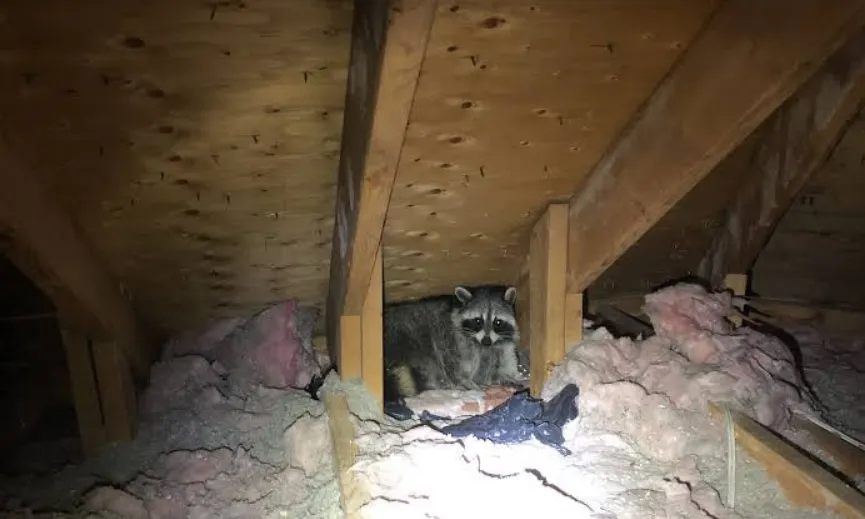
You hear it in the attic first. You hear it again the next night, louder, right over the bedroom. For a homeowner around Plymouth, that sound is what starts a late search for wildlife removal plymouth mi, and the real question underneath it is money. This is a plain cost breakdown of what one raccoon in a 1,900 square foot colonial actually runs, whether you fight it yourself or hire the job out. The short version fits in one sentence. Paying a pro to remove the animal and seal the entry costs less over a year than doing it yourself. The DIY route means trapping the same raccoon three times and patching the same soffit three times.
None of the individual line items are the scary part. The scary part is paying every one of them twice.
Scratching Overhead Rarely Stays a Small Problem
A raccoon in the attic is almost never a one-night guest. In spring and early summer, the animal tearing your soffit is usually a female looking for a quiet, dry place to raise a litter, so you are not dealing with one raccoon but with four or five once the kits arrive. The case we see most often is a homeowner who traps a single adult in April, assumes the attic is empty, and learns in June that three kits were tucked behind the chimney the whole time. Meanwhile the entry point keeps widening. Raccoons are strong, and a torn corner of soffit becomes a foot-wide hole after a few nights of coming and going. That torn soffit was basically a welcome mat. Once it is open the damage compounds, from flattened insulation and droppings to chewed wiring and stained drywall in the rooms below. On a colonial this size those repair bills climb into the low thousands fast, and most of it is invisible from the driveway.
Adding Up DIY Attempts, Traps, and Repairs
Say you decide to handle it yourself on that 1,900 square foot house. Two live traps run about $40 each, call it $80. Bait, heavy gloves, and a decent headlamp add another $30. Renting a ladder tall enough to reach the soffit is $45 for the weekend. A roll of hardware cloth and a tube of sealant to patch the hole come to $60. You catch one raccoon and feel finished. Two weeks later the kits reopen the same soffit, so you buy a one-way door kit for $70 and patch the spot again for $50. Then the droppings spread through the insulation and you pay for an attic cleanup, roughly $400 on the low end. That comes to $865 before a single square foot of ruined insulation gets replaced.
Here is the cost the receipt never shows. Every week that soffit stays open, it invites more than raccoons, because mice and other rodents slip through the exact same gap. That matters more than it used to. In May 2026, UCHealth reported that researchers near Westcliffe recorded up to 70% of deer mice carrying hantavirus, a 28-year high. Michigan is not Colorado, but the lesson travels. An open attic is a health exposure, not just a repair bill, and that is a line no DIY tally captures.
One Professional Exclusion Job Priced Out
Now price the professional route on the same house. A wildlife company inspects the whole roofline, finds every entry point, and installs one-way doors so the raccoons leave on their own but cannot get back in. Once the attic is confirmed empty, the crew seals the openings with steel and handles the cleanup and sanitizing in one visit. For a modest two-story colonial, that removal and exclusion work commonly lands in the high hundreds to low thousands, depending on the number of entry points and how far the mess spread. The number is not a tiny one. But it is paid once, and a reputable company backs the exclusion with a multi-year warranty, so a returning raccoon becomes their problem instead of your next invoice.
The sealing is the part most homeowners underprice. A properly closed roofline keeps out the rodents that follow raccoons through the same holes, and that is not a small category of pest. The U.S. Environmental Protection Agency ties rodents to more than 35 diseases that spread to people, which is why a sealed attic is worth far more than the one animal you happened to see. Here is a simple rule worth keeping in your head. If your DIY tally has already passed about $500 and the raccoon is still getting back in, hiring the exclusion out is almost always the cheaper option from that point on. The math is no longer close once you are patching the same hole a third time.
The Number That Should Drive Your Decision
Put the two columns next to each other. DIY on that colonial realistically runs $865 and keeps climbing, because the animal keeps returning and the entry stays open between attempts. The one-time professional job costs more up front but ends the cycle, warranty included. When a homeowner compares a real quote for wildlife removal plymouth mi against another full season of trapping and patching, the sealed-once number is the one that holds up. Paying once to remove and seal beats paying three times to chase the same raccoon. What I still cannot tell you, before we actually open the ceiling, is how much insulation is ruined. That single line swings the total more than any other, so anyone who quotes attic damage sight unseen is guessing. That uncertainty is the real argument for acting early, while the hole is still small and the litter has not arrived.
