
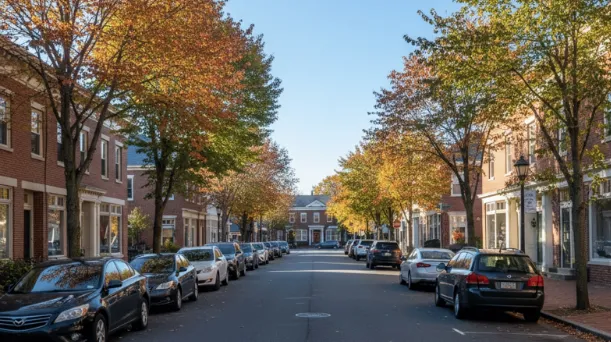
Waltham sits about 11 miles west of downtown Boston. In real life, that means the driving distance between Boston and Waltham is roughly 10–11 miles, and the trip usually takes 20–30 minutes by car, depending on traffic. You can get from Waltham to Boston by taxi or car, MBTA commuter rail to North Station, or bus routes like the line 70 bus, so it’s an easy daily commute for most people.
If you’re trying to decide whether living in Waltham works with a Boston job, that 11-mile radius is exactly what local Waltham real estate agents use to help buyers match neighborhoods with the commute they actually want.
How Far Is Waltham from Boston, Really?
On a map, the distance from Boston to Waltham is short: about 10–11 miles from downtown Boston to Waltham Center. In light traffic, it often takes approximately 20 minutes to drive from Boston. During rush hour, most people plan for 30–40 minutes each way.
Flip the route and the numbers are the same for Waltham to Boston. The distance between Waltham and Boston doesn’t change; it’s your departure time, chosen route, and traffic that stretch or shrink the commute.
You don’t need a distance calculator to figure out how far it is between these two cities. They’re close enough that commuting is very realistic; the real question is which way to travel fits your routine.
Best Ways to Get Between Waltham and Boston
There are three main ways to get from Waltham to Boston (and back again):
- Driving by car, taxi, or rideshare
- MBTA commuter rail on the Fitchburg Line
- MBTA bus routes, including the line 70 bus
1. Driving: Taxi, Rideshare, or Your Own Car
The simplest way to get from Boston to Waltham is to drive.
- Driving distance between Boston and Waltham: roughly 10–11 miles
- Typical travel time: 20–30 minutes outside rush hour
- Peak times: plan on 30–40 minutes depending on traffic
You can use your own car, a taxi, or a rideshare service. If you already have parking on both ends, driving is often the cheapest way to get between Waltham and Boston day-to-day. You also get maximum flexibility for errands, meetings, and last-minute schedule changes around the Boston area.
If you hate paying for parking garages or sitting in stop-and-go traffic, though, it’s worth looking at the train.
2. MBTA Commuter Rail: Waltham to North Station
For many commuters, the MBTA commuter rail is the best way to get from Waltham to Boston without dealing with highway traffic.
- The Fitchburg Line connects Waltham to North Station in downtown Boston
- The train, which takes about 25–30 minutes, runs several times a day
- Once you arrive at North Station, you can walk or hop on the subway to reach most downtown job centers
This is an especially good option if you live near the Waltham station or want to live in Waltham without a car. You trade some flexibility for a predictable travel time and no parking hassle. For a lot of daily commuters, that’s an easy trade-off.
3. MBTA Bus Options, Including the Line 70 Bus
The MBTA operates a bus network that ties Waltham into Cambridge and Boston. One of the most important routes for commuters is the line 70 bus, which runs through Waltham and into Cambridge, where you can connect to the Red Line and other parts of the city.
If you’re closer to a bus stop than the train, line 70 can be the cheapest way to get into Boston, especially with a monthly pass. It’s also a useful backup when commuter rail schedules don’t line up with your work hours.
Getting Between Waltham and Boston Without a Car
You don’t need to own a car to make Waltham work. Many people get from Waltham to Boston by combining:
- Commuter rail to North Station
- Bus routes like line 70 into Cambridge and Boston
- Occasional rideshare or taxi trips when they’re out late or traveling off-peak
In that case, the decision isn’t whether you can travel without a car; it’s whether your schedule matches the MBTA’s. If you work fairly standard hours, trains and buses can cover most of your total travel needs and keep your commute consistent.
Airport Access: BOS and the Closest Airport to Waltham
The closest major airport to Waltham is Logan International Airport in Boston, with the airport code BOS.
- Distance from BOS to Waltham: around the mid-teens in miles
- Travel time: usually 25–35 minutes by taxi or car, depending on traffic
Most travelers take a direct drive by taxi, rideshare, or rental car from BOS to Waltham. If you’re comfortable with transit, you can also pair airport shuttles or the subway with the commuter rail to get from Boston Logan to Waltham without driving yourself.
From a relocation perspective, this is another point in Waltham’s favor: you’re close to both downtown Boston and the region’s main airport, without needing to live right in the city.
So… Is It Better to Drive or Take the Train?
If you want a simple rule of thumb for Boston to Waltham and Waltham to Boston:
- Drive or use rideshare if you value flexibility, often work odd hours, or need to bounce around the Boston area during the day.
- Take the MBTA commuter rail if you want predictable travel time and hate dealing with parking garages.
- Use bus routes like line 70 if you’re near the line and want the lowest daily cost.
The distance between cities is short either way. Once you know the distance from Boston and the typical travel time, it’s really about which option lines up with how you like to travel.
Is Waltham a Good Home Base If You Work in Boston?
If you’re considering moving, the real question isn’t just “How far is Waltham from Boston?” but “Does that commute work with the kind of life I want?”
Waltham offers:
- A close, 11-mile commute to downtown Boston
- Multiple ways to travel: car, commuter rail, and bus
- A true downtown in Waltham Center, plus access to the Charles River and Route 128 job hubs
That combination makes Waltham a strong home base for Boston professionals who want a little more space without giving up city access.
At that point, the decision comes down to neighborhoods and price points. Stewart Woodward at the Metro West HOME Team spends every day helping buyers choose streets and homes that match their preferred commute—whether that means walking to the train, jumping quickly onto the highway, or relying mostly on bus routes and rideshare.
