
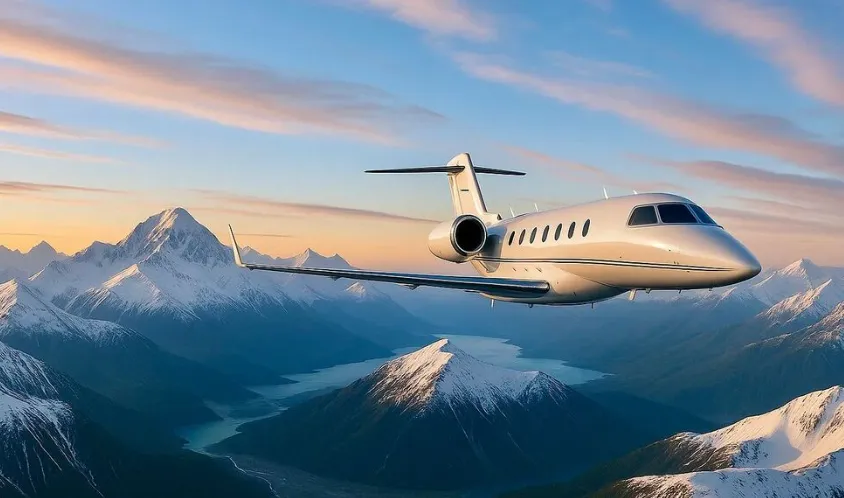
Flying in private jets changes everything. Not just the comfort of the cabin or the speed through security. It changes where you can go and how you arrive. Commercial routes are fixed. Private aviation is not. And that distinction opens doors to some of the most remarkable travel experiences on earth.
Most travelers never consider what becomes possible once you remove the constraint of scheduled airlines. Remote islands, mountain airstrips, and small regional airports suddenly enter your orbit. The world gets bigger. Yet paradoxically, destinations feel more personal, more intimate, less like a product and more like a discovery.
5 Private Jet Experiences Worth Every Dollar
| Experience | Why Private Jet Makes It Special | Best Season |
| African Safari (Botswana) | Fly directly to bush camps; skip Johannesburg layovers | May – October |
| Maldives Island-Hop | Land on multiple atolls in a single day | November – April |
| Patagonia Wilderness | Access airstrips near Torres del Paine impossible commercially | December – February |
| French Riviera Circuit | Nice, St. Tropez, Monaco — one morning, three places | June – September |
| Bhutan Cultural Immersion | Paro Airport demands trained pilots; private gives scheduling freedom | March – May |
The African Safari Done Right
Botswana’s Okavango Delta is, without question, one of the greatest wildlife destinations on the planet. But reaching the best camps, the truly remote ones, requires either a grueling multi-leg journey or air charters. Private aviation solves this in one move.
You land on a bush airstrip surrounded by elephant grass, and within twenty minutes, you are on a game drive. No transit hotels. No delays. No wasted days. The experience begins the moment wheels touch down, and that matters more than people admit.
Furthermore, flying private in Southern Africa means you can combine Botswana, Zimbabwe’s Hwange, and Zambia’s South Luangwa into a single multi-stop safari itinerary that would be nearly impossible to assemble through commercial routes. This is not a luxury for its own sake. It is efficiency that protects your most limited resource: time.
Maldives: The Island-Hopping Argument
Most visitors to the Maldives stay at one resort. They fly in, spend five or six nights, and fly out. That is a perfectly fine holiday. However, the Maldives comprises over 1,000 islands spread across 26 atolls, and confining yourself to a single property means seeing only a fraction of what exists.
Private aircraft, specifically seaplanes and light jets, make island-hopping genuinely practical. Breakfast at one resort. Snorkeling for a second. Dinner watching the sun sink behind a third horizon. The geography stops being an obstacle and becomes the adventure itself.
Patagonia: Where Commercial Aviation Simply Stops
Torres del Paine looks unreal in photos. But when you’re actually there, standing below those granite peaks while the wind cuts straight through your jacket. It hits differently. The hard part is getting in.
Punta Arenas is the nearest major airport, and after that, things get messy. Most people spend hours transferring by road. A private charter from a smaller airstrip skips all of that and drops you close to the park instead. You don’t lose a day sitting on a bus. You’re on the trail almost immediately. For anyone serious about hiking Patagonia, that time saved is worth every rupee.
The French Riviera: A Morning, Three Countries
Most people don’t realize that Monaco, Nice, and Cannes sit barely thirty miles apart. On a map, it looks effortless. In summer, it’s anything but. A short drive can stretch into hours once traffic clogs the Riviera roads. That’s where flying changes the equation entirely.
You lift off from Nice Côte d’Azur, spend the morning walking Monaco’s harbor, then move on, touching down near St. Tropez in time for lunch. No gridlock, no recalculating arrival times. The Riviera has always been about ease and fluid movement. Road travel pins you down. Flying frees up the day.
Bhutan: Travel by Design
Paro International Airport doesn’t allow room for error. The runway sits deep in the Himalayas, ringed by peaks, with approaches that demand sharp turns and absolute precision. Only a small group of pilots are cleared to land here, and only certain aircraft are permitted. That difficulty makes private flying less about indulgence and more about control.
Bhutan is intentionally selective about tourism. It limits arrivals, values time over volume, and moves at a measured pace. Entering the country via private aviation aligns naturally with that approach. Once inside, the experience is quiet, fortresses clinging to hillsides, monasteries tucked into valleys, terrain that feels largely unchanged. Moving through Bhutan slowly isn’t a constraint. That’s the point.
