
Braces do not buy a permanent result. That surprises a lot of adults who wore metal through high school and assumed the outcome was locked in for good. Teeth drift for as long as you have them, and a retainer is the only thing holding the line. So when a patient in their late twenties notices their lower front teeth crowding again, the cause is rarely bad luck or aging. It is almost always a retainer that quietly stopped getting worn, and the fix is often a discreet round of invisalign charlotte nc treatment rather than another stint in brackets. This piece is about that slide, why it happens, and how adults reverse it before it turns into a real correction.
Straight Teeth Drift Back Without Retention
Relapse is not a flaw in the original work. The fibers and bone around each tooth keep remodeling for life, and without something to counter that pressure, teeth ease back toward where they started. The lower incisors go first, which is the relapse we see most often in the chair. A patient looks in the mirror one morning, sees a tooth that has rotated a few degrees, and swears it happened overnight. It did not. It crept over years while the retainer sat in a drawer. Clear aligners have quietly become the default answer here, and the scale is easy to underestimate. Align Technology reported to the SEC in a February 2026 filing that more than 22 million people have now been treated with Invisalign, with 2.6 million clear aligner cases shipped in 2025 alone. Minor relapse cases make up a large share of that, because the movements are small and the trays are nearly invisible.
The Retention Mistakes Adults Make Most
The first mistake is treating a retainer as a one-year assignment. Most adults are told to wear it nightly, indefinitely, and most hear “for a while.” A retainer worn for six months after braces and then abandoned buys you maybe five good years before the crowding shows. The second mistake is ignoring a retainer that no longer fits. Teeth have long memories, and once a tray gets tight it means movement has already started. Forcing it in does nothing; the fit problem is the warning. If a retainer snaps or warps, the mistake is waiting months to replace it. If it simply feels tight, that is your cue to get evaluated, not to skip the next few nights. That small if-then habit prevents most of the corrections adults end up paying for.
The third mistake is assuming relapse means starting over from scratch.
It usually does not. A tooth that has drifted a couple of millimeters is a short project, not a full course. The confusion often comes from cost anxiety, because people lump aligners in with the priciest cosmetic work they have heard about. Veneers are the usual reference point, and CBS News reported that porcelain veneers run $800 to $3,000 per tooth depending on the region and the dentist. Aligner refinement for mild relapse sits in a different category entirely, since you are nudging a few teeth rather than resurfacing a whole smile. Knowing that difference keeps people from putting off a small fix out of fear it will cost like a major one.
How Long Refixing Really Takes
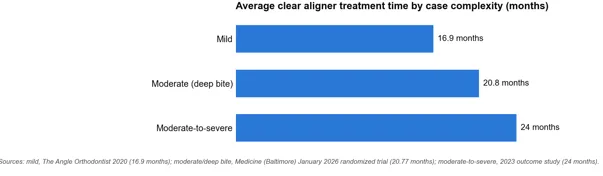
Timelines depend almost entirely on how far the teeth have wandered. Mild lower-front crowding, caught early, is frequently a matter of a few months of trays. Deeper cases with a bite component take longer, as the chart above lays out. For a Charlotte adult who caught the drift within a year or two, budget maybe six months. Honestly, closer to nine once you factor in the refinement trays most people need at the end to seat everything. The point is that waiting makes the number bigger, not smaller.
How Do I Know If My Teeth Have Actually Relapsed?
Run your tongue along your lower front teeth and check whether they still sit flat and even. A tooth that catches, twists, or overlaps a neighbor is drifting. A quick scan at a dental visit confirms it and shows how much movement has happened, which is what sets the treatment length.
Can I Just Get A New Retainer Instead Of Treatment?
If nothing has moved yet, a fresh retainer is exactly right and far cheaper. Once teeth have already shifted, though, a retainer only holds the new crooked position in place. You have to move them back first, then retain.
Refix It Quietly Before It Worsens
Post-braces relapse is common, slow, and very fixable when adults act on the early signs instead of waiting for the mirror to force the issue. The removable trays behind invisalign charlotte nc treatment let someone correct a couple of drifting teeth without announcing it to a conference room, and the shorter the drift, the shorter the fix. Watch for the tight retainer, the tooth that catches your tongue, the photo that looks slightly off. Those are the moments to move. Reverse a small slide now and you protect the result you already paid for once, instead of paying for the whole thing twice.
