
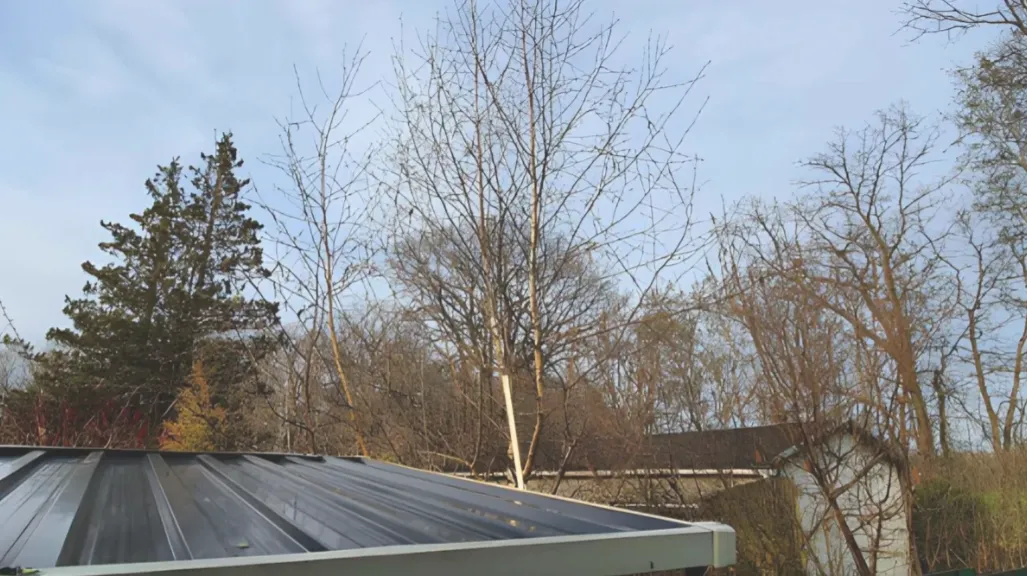
When a brand new array’s summer numbers slide while the glass stays clean, look up before you call the installer. The panels are usually fine. On one 7 kW system in Allegheny County, a silver maple standing off the south-facing slope took most of the owner’s July peak, and the fix turned out to be the sort of tree pruning Pittsburgh PA crews put on a seasonal schedule instead of an inverter service call. Here is the claim this piece is built on, with a season of meter readings behind it: canopy shade is a recurring maintenance cost, not a one-time repair. One big cut buys back a summer and then gives it away as the tree grows back into the same airspace.
Summer Output Fell While the Panels Stayed Clean
The house is a 1950s brick ranch and the array was commissioned in March: 18 modules across the rear slope, all facing south. The monthly log read 812 kWh in April, 848 in May, then 803 in June, 731 in July and 690 in August. A Pittsburgh array should climb into a June and July peak and hold it. This one did the opposite, and it fell further every month the maple leafed out. The owner washed the modules himself in late June and the August number still came in lowest, which took soiling off the table before anyone had to argue about it.
A July 2026 homeowner maintenance guide from Surf Clean Energy, working off National Renewable Energy Laboratory research, put the range for soiling and shading losses at 1.5% to more than 25%, depending on local conditions, tree coverage and how often the system gets maintained. A spread that wide is not much use on its own. It does tell you that the gap between a trivial loss and a quarter of your production is mostly whatever stands next to the roof, and what we see most often on these calls is the high end, on lots where a mature hardwood sits south of the panels.
Shade Was Not the Only Cost
Shade was the biggest line item, though not the only one. Silver maple drops seed in late spring and small dead twigs all summer, and both collect along the lower frame edge where the module meets the rail. Debris there holds water against the frame and the mounting hardware, and a wet strip of organic matter on a hot roof is how staining and corrosion get started. By August a storm had also loosened a limb that was resting across two modules in the bottom row.
A limb lying on a module is not a shade problem. It is a warranty problem, and it gets worse with every wind event until somebody removes it.
A landlord with two duplexes a few streets over learned a related lesson in November, when his roofer refused to warranty a re-shingle under a limb that was already touching the deck. The tree work had to be booked first, in the middle of a tenant turnover, at whatever price was available that week. Scheduling the canopy ahead of the other trades costs less than scheduling it behind them.
An Arborist Read the Canopy Before Anyone Cut
Nobody climbed with a saw on day one. The assessment came first: which limbs cross the June sun path, which cross the lower September one, and which are attached well enough to keep. Those are two different sets of branches, and a crew cutting only for the mid-summer angle leaves the shoulder months untouched. The tree pruning Pittsburgh PA homeowners actually need on a solar roof is mostly thinning and lifting, which means opening the crown so light passes through it and raising the lower limbs off the roof plane so nothing touches. Topping the maple was never on the table, because a topped hardwood answers with dense weak regrowth that is back in the same space inside three or four years.
What I cannot pin down for you is how much of that August dip belonged to the limb and how much belonged to a hazy stretch of weather. Nobody meters shade separately from cloud cover, and on a single-inverter system there is no clean way to split the two after the fact. I would rather say that plainly than hand you a number I invented.
What the First Year of Pruning Actually Looked Like
The first week after the crew left, the change showed up on the monitoring app rather than in the yard: the daily curve stopped notching down at two in the afternoon. July the following year came in at 884 kWh against the prior 731, on a summer nobody would call sunnier. Within 60 days the fall visit came through for cleanup and a look at the cuts, because a maple pushes water sprouts from wherever it was opened up. By month three the crew was back in the dormant season, when the structure is visible and the larger reduction cuts are easier on the tree. The second year needed one spring pass and one check after the July storms, which is roughly the rhythm this canopy will hold from here.
Money, honestly, is where these decisions get made. Say the first structural visit runs $1,600 for a tree that size, each maintenance visit after it comes in around $450, and the recovered production averages 140 kWh a month across the peak season. At Pennsylvania residential rates that recovery is worth roughly $25 a month while the sun is high, so the pruning does not pay for itself out of the meter alone. It pays for itself once you add the roof, the modules, and the limb that would otherwise come down on its own timetable.
Questions Solar Owners Ask About Canopy Work
Can I Cut the Limb Over My Panels Myself?
No. Never prune from a ladder or a roof near an energized array, and stay away from anything close to overhead service conductors, because fatal electrocution is the main hazard in that work; OSHA’s guidance on solar electrical safety requires keeping at least 10 feet of clearance from overhead power lines and sends anything nearer to qualified workers. Call the utility about the service drop and a qualified arborist about the tree.
Will Canopy Pruning Affect My Solar Warranty?
The pruning itself never touches the array, so the tree work is not the exposure. Abrasion or debris damage that was allowed to sit is a different matter, since module coverage generally speaks to defects rather than damage from outside objects. Photograph the roof before and after any canopy work, keep the dates, and ask your installer directly what their coverage says about contact damage.
How Often Does a Canopy Near an Array Need Attention?
For a fast-growing hardwood over a roof, once a year is the honest answer, with the heavier structural work saved for the dormant season. Slower species can stretch to every other year as long as nothing is within reach of the modules. The real trigger is clearance rather than the calendar, because new growth sitting a couple of feet off the panels is already shading them at low sun angles.
Clearance Is a Schedule Not One Cut
The maple is still standing, which was always the point. It got smaller in the right places, the array got its afternoons back, and the owner now has a tree on a schedule instead of an emergency waiting for the next August. The production log does not argue. If your array sits under a canopy, book the assessment before the season you want the output in, not after you have watched a summer of it disappear, and plan on a visit a year rather than one dramatic rescue.
