
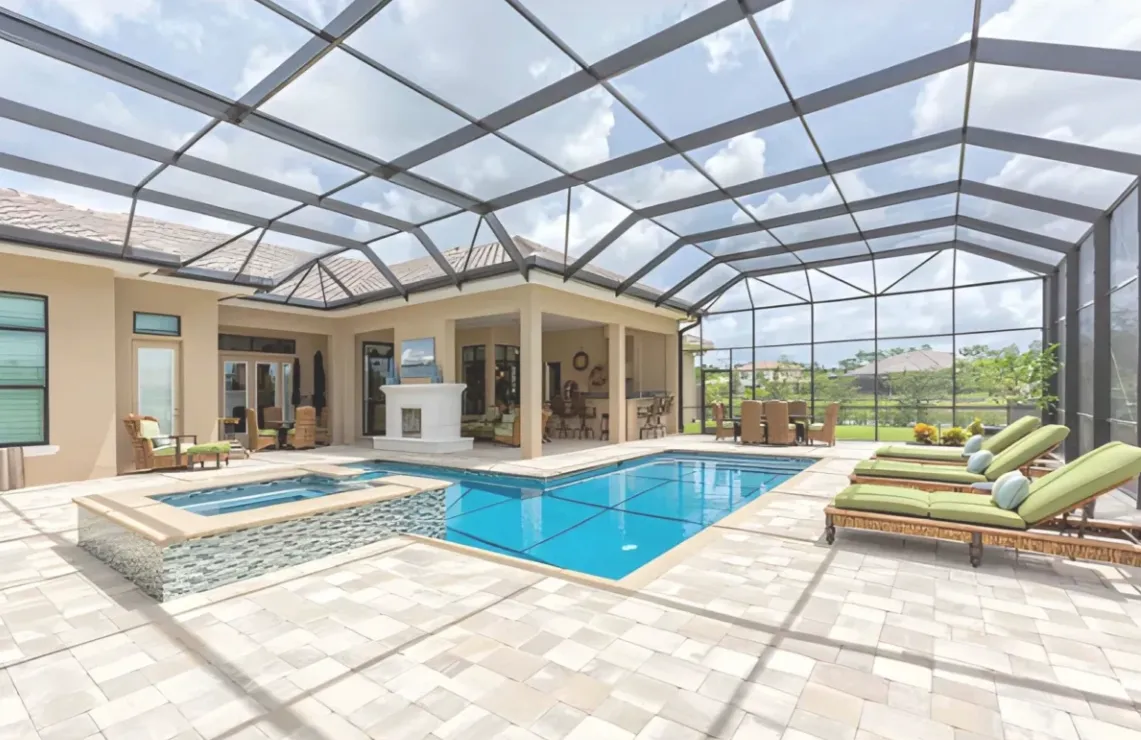
Rescreening looks like the thrifty choice, and for nine months of the year it is. For the owner who locks up a Gulf Coast villa in May and does not turn the key again until October, the annual rescreen is quietly the expensive path, which is why searches for glass exterior doors sarasota fl climb every fall. Here is the argument in one line: on a seasonal home, replacing a screen wall with a sealed glass enclosure costs less across a decade than paying for screen year after year, and it hands over a usable room instead of a cage that keeps failing. The rest of this is how to test that against your own house.
Rescreening Is a Standing Bill, Not a Repair
Start with one specific house, because averages hide the problem. Say it is a 1990s canal-side villa near Bradenton, roughly 1,900 square feet, with a 12-by-30 screened lanai and an outdoor kitchen along the back wall. The owner flies north in early May. Between then and October that lanai catches every squall line rolling in off the Gulf, and nobody is there to pull cushions inside or push standing water off the pavers. A lanai left alone all summer takes the weather personally.
The damage is rarely dramatic. Torn screen, popped spline, a bent kickplate, two panels that let go at a corner. Say a full rescreen of that 360 square feet runs $1,400 in labor and material. Call it $1,400 a year. Honestly, closer to $1,900 in the seasons when a frame member twists and someone has to reset it square, and neither figure counts the mildewed cushions or the rust working its way under the grill cabinet.
Set that against the one-time number. Precision Aluminum and Patio published a cost breakdown in March 2026 pegging Florida glass enclosures at $30 to $80 per square foot, which is roughly $9,000 to $24,000 on a 300-square-foot lanai. At the low end of that range, against a hypothetical $1,400 rescreen every year, the crossover lands somewhere in year seven, and everything after that is money the house keeps. Specify premium impact glass and wide sliding walls and the crossover stretches past a decade, which is why the decision really turns on how long you plan to own the place.
Screen is a consumable. Almost nobody sells it that way.
A Glass Enclosure Is an Engineered System
Swapping screen for glass changes the physics of the structure, and that is the part a driveway estimate tends to skip. A screen wall lets wind pass straight through it. A glass wall does not, so pressure that used to blow out into the yard now loads the beams, posts, fasteners and slab edge that were sized for aluminum and mesh. That is structural work. It needs a permit and a licensed contractor working to the wind-borne debris requirements that apply at your address, and it is never a weekend panel swap.
The paperwork reflects that reality. Hillsborough County’s residential checklist for screen enclosure and glass room additions requires plans for a screen-to-glass-room conversion to be designed and sealed by a State of Florida registered architect or engineer in accordance with the current Florida Building Code, wind load compliance and structural design certification included. Requirements vary by county and by wind zone, so read what your own building department publishes before signing anything. A contractor who shrugs at the sealed-plans question is telling you something useful for free.
Anyone comparing glass exterior doors Sarasota FL contractors actually install will find the systems sort into a handful of shapes: sliding glass door walls, stacking or telescoping panels, hinged units set into fixed glass, and the occasional fold-away assembly. Impact-rated products carry a design pressure rating and a Florida product approval number, and those numbers are what a plans examiner reads. Finish and frame color matter far less than a showroom suggests. Job after job, the failures we see start at the anchors and the sill pan, not in the glass.
Questions That Sort Real Installers From Salesmen
The money leaks at the quoting stage. Two quotes on the same lanai can sit $8,000 apart, and the gap is almost never the glass itself; it is whether engineering, permit fees, footing work and hardware are inside the price or waiting for you in a change order. Ask in a way that forces a specific answer.
- Who seals the structural plans for this job, and is that fee inside your price? A good answer names the engineering firm and a dollar figure.
- What design pressure and product approval number does the door system carry? A good answer is a number they can point to on a spec sheet, not a brand name.
- Will the existing footings and slab edge carry a glass wall, or does something get reinforced? A good answer describes what they will open up to find out.
- Which parts of permitting and inspection do you handle, and what is left to me? A good answer walks the timeline from application through final inspection.
Listen for the answer that comes with a date attached. A shop that has finished twenty of these can tell you plan review in its county ran about three weeks last spring; a shop that has finished two will talk about how fast it usually is. Ask who physically shows up, too. Subcontracted glass crews are common and not a problem by themselves, but you want that answer before the truck pulls into the driveway.
Deciding Before Hurricane Season, Not After
Timing decides how much of this you get to enjoy. The rule worth remembering is simple: if you live in the house nine months a year and your screen lasts five seasons, keep rescreening. If the place sits empty from May through October and you have already paid for screen twice in four years, glass wins the second time you write that check.
The calendar is less forgiving than the budget. Sealed plans, permit review, product lead times and a good crew’s schedule stack on top of each other, so an owner who decides in August is usually looking at glass going in after the season rather than before it. Decide in the fall, while you are standing there looking at the damage, and the work tends to land in the quiet stretch between January and April.
What you are buying is a lanai that no longer needs you watching it. Sealed glass keeps rain off the outdoor kitchen and pulls 360 square feet of screened porch inside the conditioned envelope of decisions you make about the house, instead of leaving it out in the weather to be repaired again. So the case stands: an annual rescreen is a subscription to the same problem, and a properly permitted, properly engineered glass enclosure cancels it. Get two quotes, ask who seals the plans, and let the numbers settle the argument.
