
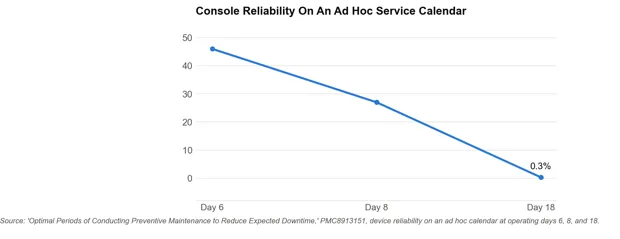
Why do the same two consoles in a four-location ophthalmology group keep failing the week before a heavy cataract list? The machine is usually not the real cause. In practice it traces back to how each site schedules service, which is why a documented preventative maintenance for phaco machine plan across the fleet beats any single heroic repair. A mixed fleet of Centurion and Constellation units running on four calendars fails in clusters, and those clusters are predictable. The habits below are the ones we see wreck uptime quietly.
Treating Every Machine On One Calendar
The first mistake is assuming one service date fits every console. A Centurion in a busy room and a Constellation used twice a week do not age at the same rate, yet many groups service both on the same annual tick. Think of how an airline handles its fleet. Jets come off the line by flight hours, not by the calendar, because usage is what wears the parts. Phaco consoles follow the same logic, and the room running forty cases a week needs attention long before the site running eight.
The stakes climbed this year. In March 2026, Ophthalmology Management flagged a 2.5 percent work RVU reduction on most non-time-based CPT codes, cataract surgery included, so every delayed case costs a little more than before. When reimbursement tightens, an avoidable day of downtime stops being a nuisance and starts cutting into thin margins. A console that drops out mid-week can bump a dozen cases, and that gap is usually the machine nobody put on a firm schedule.
Ignoring Fluidics Until Performance Slips
Fluidics is where neglect shows up first, and the warning signs stay subtle. Chamber stability drifts, then a vacuum that reads fine at rest sags under load, and the surgeon feels it before any log does. This is not a niche worry, because cataract volume is large and uneven. A study in JAMA Ophthalmology put the national cataract rate at 769 per 10,000 beneficiaries aged 65 and older, from 538 in the Northeast to 1,025 in the South. A Southern multi-site group runs its consoles far harder than the purchase date suggests. That is why a shared preventative maintenance for phaco machine schedule should weight fluidics checks by real caseload.
The pattern we see most often is a console limping along on borrowed time, patched between cases until a pump quits during a full list. By then the fix is not a calibration but a parts order and a lost day. A caseload-weighted check catches that drift while it is still a quick adjustment.
Letting Software Updates Fall Behind
Software updates are the easiest habit to let slide. Firmware and application patches land through the year, and four sites on four schedules leave consoles running different versions of the same platform. That divergence turns a simple loaner swap into a compatibility puzzle and muddies the service records surveyors expect. Here is where the problem drifts into procurement’s lap, since version sprawl starts with staggered purchase dates and no owner for the update log. Back to the schedule: fold firmware checks into the same fleet-wide interval as the hardware, so every console lands on the current version together.
In practice the update gap stays invisible until it is urgent. A recall or security patch arrives, and the group finds that two consoles cannot take it without a step nobody planned. Standardizing the cadence removes that whole scramble.
How Often Should A Phaco Console Actually Be Serviced?
Tie the interval to caseload, not to a flat annual date. A busy room usually needs a full check every few months, while a light satellite site can stretch longer without added risk. One fleet-wide rule applied to uneven usage is what causes the clustered failures.
Does A Standardized Schedule Cost More Than Ad Hoc Repairs?
It almost always costs less over a year. Ad hoc service looks cheaper per visit, but it trades small planned adjustments for large unplanned ones, plus the lost revenue of a mid-week outage. A multi-year agreement also leaves the documentation reimbursement and accreditation expect.
Standardized Schedules Fix The Pattern
None of these habits is dramatic on its own, which is exactly why they get missed. One calendar for mismatched consoles, fluidics left until it slips, and updates drifting apart add up to downtime a busy group cannot absorb. Put the whole fleet on one weighted, documented schedule and the clusters flatten, because failures get caught as adjustments instead of emergencies. A four-location group does not need heroics from its service tech; it needs the same interval on every console, tuned to how hard each one works.
